The problem with disconnected GST billing
Indian hospitals and pharmacies rarely fail GST because staff forget tax percentages—they fail because billing lives in a different world from reception, consult, inventory, and TPA follow-up. A pharmacist re-types a prescription into a standalone POS. Finance exports CSV files that do not match batch movement. Returns are processed in a notebook while the register shows a clean sale. Multi-branch groups discover mismatches only when the CA asks why Hyderabad and Mumbai registers disagree. Standalone GST billing software can print a compliant-looking invoice while the operational truth behind it is fragmented. That fragmentation creates audit friction, margin blind spots, and month-end arguments between pharmacy, billing, and accounts—long before any statutory filing conversation begins.
Traditional workflow: standalone billing and parallel tools
The traditional pattern stacks independent products: an appointment app, a doctor notebook or lightweight EMR, a pharmacy POS, TPA aging in spreadsheets, and Tally or Busy for accounts. Reception checks in a patient in one system. The physician writes a prescription on paper or in a siloed module. The pharmacy counter keys items again into billing software that knows nothing about queue order or payer category. GST lines may be correct on the printed bill while inventory still shows full stock. TPA cases get a cash bill first and a reconciliation row later—sometimes in another person's spreadsheet. Offline outages force a paper shadow register that never perfectly matches the daybook upload. Each tool may handle GST adequately in isolation; the hospital or pharmacy still pays the cost of re-entry, mismatch, and explainability every day.
Hayati workflow: GST billing on the Healthcare Operating System spine
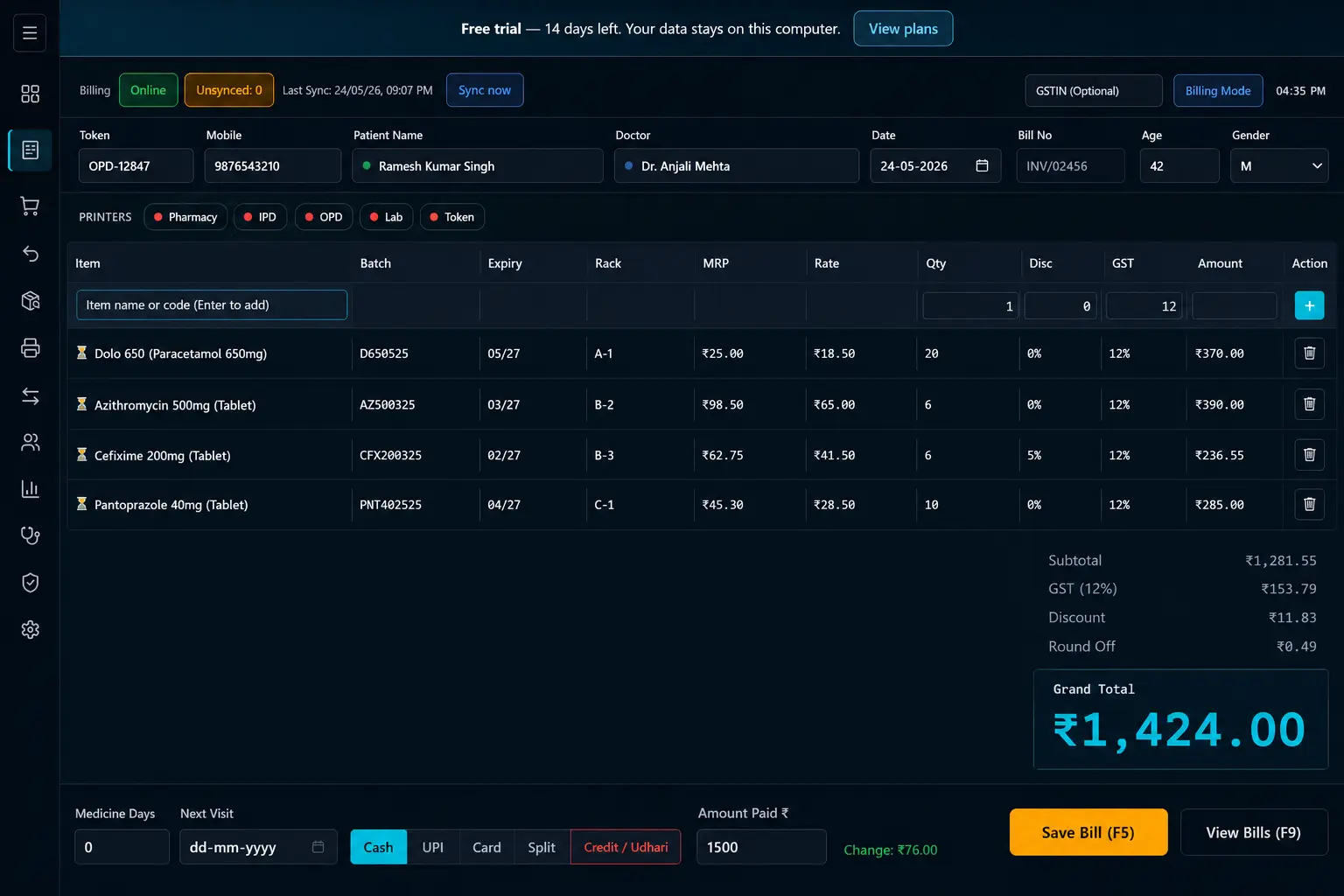
Hayati treats GST billing as a workflow stage on one Healthcare Operating System—not a separate SKU. Patient context begins at governed AI reception or the Physical Appointment Dashboard and flows through queue and Doctor Dashboard when enabled. Charges and prescriptions reach the billing counter without a second interpretation of who was seen and why. At dispense, Smart Billing applies HSN mapping, multi-rate GST lines, discounts, returns, and payment modes—including UPI QR where configured—while pharmacy inventory consumes the same batch on the same event. Counters print GST-shaped receipts on thermal or A4 formats your finance team validated. Sales and purchase registers plus HSN summaries feed CA review; GSTR-1, GSTR-2, and GSTR-3B–oriented tooling and GSTR-2B reconciliation views help accounts compare books to portal downloads before filing conversations begin. E-Invoice IRN workflows apply where your GSTIN policy requires them—scoped with your CA, not assumed for every counter. TPA or credit categories stay attached to the bill record finance reviews before portal work. Offline-first counters record the sale locally, print from local masters, and replay events to governed sync when the link returns—branch context intact so HQ does not merge counters blindly. Returns, voids, and exceptions preserve a trail across stock, tax, and payer flags instead of becoming a side conversation in WhatsApp.
Benefits for hospitals, clinics, and pharmacies
Operators gain fewer re-keying steps between consult, dispense, and accounts. Pharmacists spend less time arguing with yesterday's spreadsheet about batch quantity. Finance receives sales and purchase registers and HSN summaries tied to operational events—not reconstructed narratives—plus GSTR-oriented exports and GSTR-2B reconciliation views that shrink month-end mismatch hunting. Multi-branch groups review branch-scoped GST activity without flattening every facility into one ambiguous ledger. Hospital pharmacies validate payer-linked bills alongside cash, credit, and UPI QR collections on the same counter discipline retail pharmacies expect. Thermal and A4 print paths keep patient-facing invoices consistent online and offline. Clinics with dispensaries connect OPD queue, consult, and billing without buying four products. None of this replaces your CA or statutory judgment; it reduces avoidable internal mismatch so review happens on cleaner evidence. Teams still close registers, still validate returns, still scope e-Invoice IRN and filing policies with advisers—but they stop paying the daily tax of disconnected modules pretending to be an operating system.
AI integration on the billing workflow
AI on Hayati is governed operations—not magic autocomplete on a standalone biller. AI Receptionist captures after-hours appointment intent and hands structured context to reception so the patient's queue and billing path starts before they reach the counter. Queue management keeps waiting order aligned with who is actually in consult, reducing wrong-patient bills at busy OPD hours. Doctor Dashboard surfaces prescriptions and charge flags so billing staff are not guessing what the physician intended. AI Retention Agent may seed follow-up visits that later produce billable OPD flow—always with staff oversight, never silent mutation of finalized registers. AI does not file GST returns or approve TPA settlements; it reduces missed intake and ambiguous handoffs that become billing errors downstream. Scope language packs, escalation, and which AI modules are enabled during walkthrough—not every branch needs every agent on day one.
Connected modules on one Healthcare Operating System
GST billing reads and writes context across the modules Indian operators actually run together: AI Receptionist for inbound calls and booking handoff; queue management and Patient Queue Display for OPD order; Doctor Dashboard for consult and prescription context; Smart Billing (this workflow) for GST registers, HSN summaries, GSTR-oriented exports, GSTR-2B reconciliation, and e-Invoice IRN where scoped; pharmacy inventory for FEFO batch movement; TPA billing alignment for cashless and payer-linked cases; multi-branch governance for governed sync and HQ visibility; offline billing for the same workflow—including thermal/A4 and UPI QR—when connectivity drops. Product and platform pages describe architecture; this page describes the billing stage on that spine. Walkthroughs should trace one patient from call or check-in through consult, dispense, and register export—not demo an invoice template in isolation.
Comparison: standalone GST software vs Healthcare OS workflow
Standalone GST billing or accounting-led tools excel when the buyer only needs invoices and ledgers. Hayati fits when billing must stay consistent with queue, consult, inventory, TPA, and branch policy on one spine. Marg-style desktop ERP may suffice for trading counters; it is weaker when hospital pharmacy, ward sales, and payer mix need shared patient context without re-entry. Tally-class accounting is not an OPD queue or AI reception layer. Cloud HMS products may bill online until the ward Wi-Fi drops. Hayati's comparison claim is narrow: fewer internal mismatches between counter, stock, and finance evidence—not a promise that every filing or payer portal disappears. Evaluate with your CA present for tax format, your pharmacy lead for batch returns, and your finance owner for TPA aging—not with a generic invoice PDF alone.