Is offline billing a separate product from Hayati GST billing?
No. It is how Smart Billing and related workflows behave when connectivity drops on the same Healthcare Operating System—local capture first, governed replay second.
Healthcare OS workflow · Offline billing
Offline-first billing is how Hayati AI Nexus—a Healthcare Operating System—keeps reception, queue, consult, GST registers, inventory, and TPA flags continuous when Indian networks fail, then replays events with branch context when sync returns.
Desktop license—activate on your machine after verified payment. Not a cloud trial signup.
Offline billing workflow on a Healthcare Operating System is local-first capture of GST-shaped sales and related operational events at the counter when connectivity drops, followed by governed replay to headquarters and cloud services you enable—without a separate offline mode ritual, shadow registers, or a standalone POS disconnected from queue, inventory, and payer context on the Healthcare Operating System spine.
Network drops
Same counter flow continues locally
Bill + batch
GST lines and inventory on one event
Queue & consult context
Patient path preserved on register
TPA / credit flags
Payer category stored with bill
Connectivity returns
Idempotent replay with branch context
HQ visibility
Multi-branch review when sync policy allows
Indian pharmacies and hospital wards lose internet at the worst moments: evening OPD rush, monsoon outages, router reboots during ward sales, and month-end closings when every minute of queue matters. Cloud-only registers treat disconnect as an exception—staff switch to paper, patients wait, and finance reconstructs the day from handwritten notes. Standalone offline POS may keep selling but drops patient, TPA, and inventory context that headquarters expects. Multi-branch groups suffer duplicate uploads, merged counters, and WhatsApp photos of registers as audit evidence. The problem is not only downtime—it is that billing ceases to be part of an operating system and becomes an island that syncs late, wrong, or twice. Owners then pay twice: once in lost sales patience at the counter, again in finance hours rebuilding trust in the daybook.
Traditional continuity stacks manual rituals on top of cloud billing: paper tokens, duplicate notebooks, USB daybook exports, and late-night uploads when the link returns. Reception may use one queue while the offline register knows nothing about who is waiting. Pharmacy inventory counts drift because dispense happened on paper. TPA-linked ward sales lose payer flags until someone re-keys them. Doctor prescriptions sit on paper while the counter guesses items. When sync finally runs, HQ cannot trust which branch created which event—or whether the same sale uploaded twice. Staff blame the network; auditors blame the process. Standalone offline billing apps reduce one pain point while leaving the Healthcare Operating System story unfinished. The hospital still trains separate procedures for disconnect days versus normal days—a sign the workflow was never truly unified.
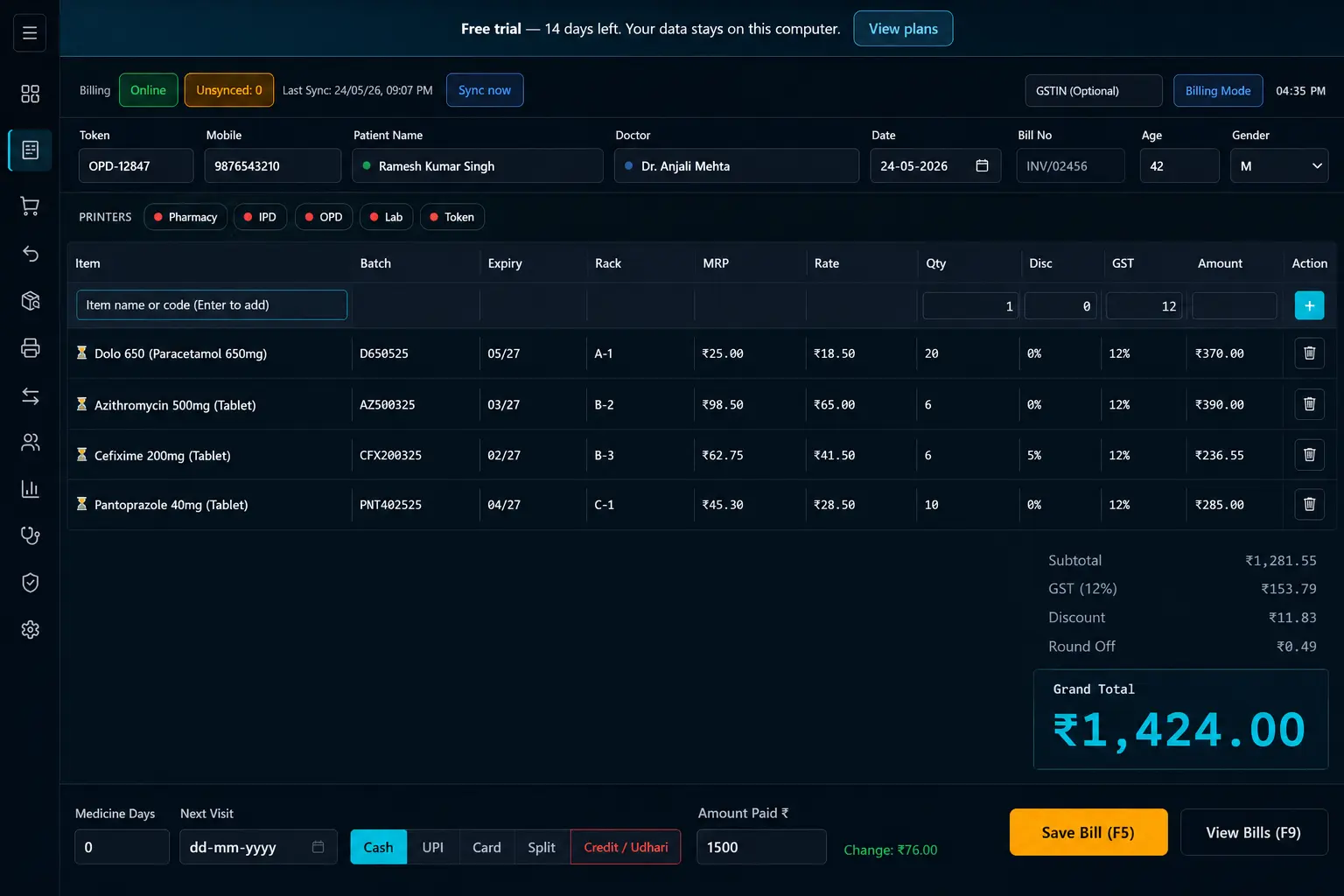
Hayati is offline-first by design on one Healthcare Operating System spine—not a toggle staff must remember. The same billing flow runs locally: patient and queue context from reception or AI Receptionist, consult handoffs from Doctor Dashboard when enabled, GST lines and batch picks with pharmacy inventory, TPA or credit flags for hospital pharmacies, and local thermal (or A4) print where printers are configured. Shift cash control stays on the counter for day-close discipline—collections by user and mode before bank deposit—not a cloud-only ritual that vanishes when the wire drops. When connectivity returns, events replay to governed cloud sync with branch context so multi-location groups do not merge counters blindly. Retries aim to be duplicate-safe in plain language—network flaps should not inflate HQ totals. Conflict rules for edge cases are documented during enterprise onboarding. Dual-control restore protects backup recovery from single-person accident—restore is not the same as sync. Offline scope is honest: certain cloud-only reports, fresh master downloads, or third-party portals may wait until online—validated on walkthrough, not assumed in a hotel demo. The goal is one patient journey whether the router is up or down—not two parallel operating manuals.
Counters keep serving patients without visible queue freezes patients remember—and keep printing local thermal receipts when USB to the printer is up even if WAN is down. Finance receives one operational trail instead of paper plus cloud reconstruction, including shift cash control evidence for day close. Pharmacy leads trust batch movement stayed tied to bills even during outages. Hospital ward teams document payer-linked sales locally for later review. Multi-branch operators reduce manual daybook heroics at each location. Tier-2 and Tier-3 cities gain continuity without abandoning GST discipline. Clinics with dispensaries avoid telling OPD patients to return when Wi-Fi returns—a common failure mode of cloud-only polyclinic stacks. Benefits assume you still close registers, supervise returns, and plan desktop backup with dual-control restore where policy requires—sync is not disaster recovery by itself. Hayati removes dependency on the wire during the sale while keeping the sale part of the same Healthcare OS workflows you run online.
AI modules respect the same local-first spine. AI Receptionist can capture calls and booking intent that sync to reception when the link returns—after-hours intent should not vanish because Wi-Fi failed at the front desk. Queue tokens created offline should align with Patient Queue Display when services catch up—scope display refresh behavior on walkthrough. Doctor Dashboard handoffs queued locally still attach to bills at dispense instead of forcing pharmacists to guess prescriptions. AI does not promise infinite offline language models or cloud-only analytics during disconnect; it reduces intake loss that otherwise becomes anonymous walk-ins. Retention follow-ups scheduled before an outage should replay under governed rules rather than duplicate bookings—confirm cadence and deduplication on pilot. Measure missed-call capture and re-keying time in pilot branches with deliberate disconnect tests—not vendor uptime slogans we do not publish.
Offline billing is not an island—it replays context across AI Receptionist intake, queue management, Doctor Dashboard consult handoffs, GST Smart Billing registers, pharmacy inventory batch moves, TPA alignment flags, and multi-branch governance. Shift cash control, local thermal print, and dual-control backup restore are part of counter discipline—not cloud afterthoughts. Product and platform pages describe sync architecture; this page describes continuity during disconnect and why backup ≠ sync. Evaluation must run your scenario: evening rush, ward sale, return offline, TPA-linked bill, shift close, and HQ roll-up—not a scripted hotel Wi-Fi path. Bring IT to ask about conflict resolution, master refresh intervals, and backup expectations alongside pharmacy and finance leads.
Standalone offline POS or legacy desktop ERP may bill reliably without internet while ignoring OPD queue, AI intake, and governed multi-branch sync. Cloud HMS suites often weaken offline pharmacy and ward counters. Hayati targets operators who need GST-shaped local truth plus replay into the same Healthcare Operating System spine online and offline. Comparison claim is narrow: continuity without abandoning patient, batch, payer, and branch context—not the lowest price per register license. If you never sync to HQ and never share context between reception and pharmacy, a simpler offline tool may suffice until governance forces change. Serious buyers run a side-by-side disconnect test with their own router reboot scenario before treating either stack as production-ready.
Staff bill without switching apps or enabling a special offline mode—the register records locally by default.
Visit, token, or consult handoff stays on the bill so replay does not produce anonymous sales at HQ.
Tax lines and batch movement record together locally for later finance and stock review.
TPA or credit categories remain on the bill record for finance reconciliation after sync.
GST-shaped receipts print locally on thermal or A4 from masters synced or entered before disconnect—validate USB/LAN printer paths on walkthrough.
Returns trace to original bills and batches when rules permit—confirm void behavior on disconnect demo.
Shift cash control captures collections by user and payment mode for day-close—works on local register truth, not only after sync.
Events upload with branch context and duplicate-safe retries per onboarding documentation.
Multi-branch dashboards reflect replayed events; backup and dual-control restore remain separate from sync—conflict cases escalated per enterprise policy.
No. It is how Smart Billing and related workflows behave when connectivity drops on the same Healthcare Operating System—local capture first, governed replay second.
No. Hayati is offline-first by design. The billing flow continues; upstream sync pauses until the network is stable.
Hayati targets GST-shaped bills from local masters present on the counter, including local thermal or A4 print where configured. Confirm tax lines, formats, and printers on a deliberate disconnect walkthrough.
Day-close discipline on local register truth—collections by user and payment mode for bank deposit reconciliation. It should not depend on cloud reports that only appear after sync.
Billing, inventory, and enabled operational events replay with branch context. HQ should not merge counters blindly—validate duplicate handling on pilot.
Batch-aware dispense needs stock masters locally before disconnect. Confirm master refresh cadence and FEFO prompts during onboarding.
Yes where policy allows payer flags on local bills that finance reviews after sync. Validate ward and payer scenarios on walkthrough.
No. Sync complements but does not replace desktop backup and restore planning. Dual-control restore adds a second-person gate on recovery where policy requires—ask for data-flow and backup guidance during procurement.
Book a walkthrough with your disconnect scenario—router reboot, evening rush, local thermal print, shift close, return offline, and HQ roll-up—not a conference-room Wi-Fi script.
Explore Hayati by workflow
GST billing, FEFO inventory, and branch operations for pharmacy counters.
Keep billing locally when internet drops, then sync when the line returns.
Batch, expiry, and stock visibility built into the counter workflow.
Hospital pharmacy billing, branch context, and payer-aligned operations.
Keep pharmacy billing and reconciliation data easier to review.
Governed front-desk support without clinical overclaims.
A factual comparison for pharmacies planning a legacy ERP switch.
Discovery, trial import, validation, and phased branch rollout.
Published Starter and Growth plans, with Enterprise scoped separately.
OPD, IPD, pharmacy, lab, and radiology on one operational spine.
Treatment plans, OPG integration, and patient billing for dental practices.
Recurring sessions, patient scheduling, and compliance management.
All features: AI Receptionist · AI Retention Agent · Patient Queue Display · Doctor Dashboard · TPA billing · Multi-branch · Pharmacy inventory · GST billing · Offline billing · Queue management
We run billing with the network off, then replay GST, inventory, TPA flags, and branch context when sync returns—on your questions, not a standalone offline POS demo.