The problem with disconnected queue management
Indian OPD floors fail quietly when queue order lives in reception's memory, a paper token book, and a TV screen fed by manual updates. Patients crowd the desk asking why their name is not on the display. Physicians start consults out of sequence because the nurse shouted the wrong token. Billing staff bill patient A's medicines while patient B is still in the chair—because queue context never reached the pharmacy counter. Standalone queue display apps solve the waiting-room screen but not the operating story: who arrived, who was seen, who is waiting for dispense, and who left without closing the visit. Multi-branch groups cannot compare delay patterns when each clinic improvises. The problem is not missing a digital token—it is missing queue as a workflow stage on a Healthcare Operating System that billing, inventory, TPA, and AI intake already share.
Traditional workflow: paper tokens, shouting, and siloed displays
Traditional clinics and hospital OPDs combine paper tokens, whiteboards, and reception shouting names across the hall. Appointment apps may book slots but do not drive the live waiting-room order when walk-ins arrive. A separate queue display product polls a spreadsheet or manual refresh. Doctor Dashboard—if it exists—does not know who is actually waiting without another verbal handoff. Pharmacy counters start billing from prescriptions without queue linkage, so wrong-patient dispense risk rises at peak hours. AI phone agents, if used, dump bookings into email instead of the same dashboard reception uses. Offline outages freeze display updates while the counter still serves patients—then no one trusts the screen again. Each layer is a partial fix; none preserves patient context through consult, dispense, GST billing, TPA review, and branch roll-up.
Hayati workflow: queue management on the Healthcare Operating System spine
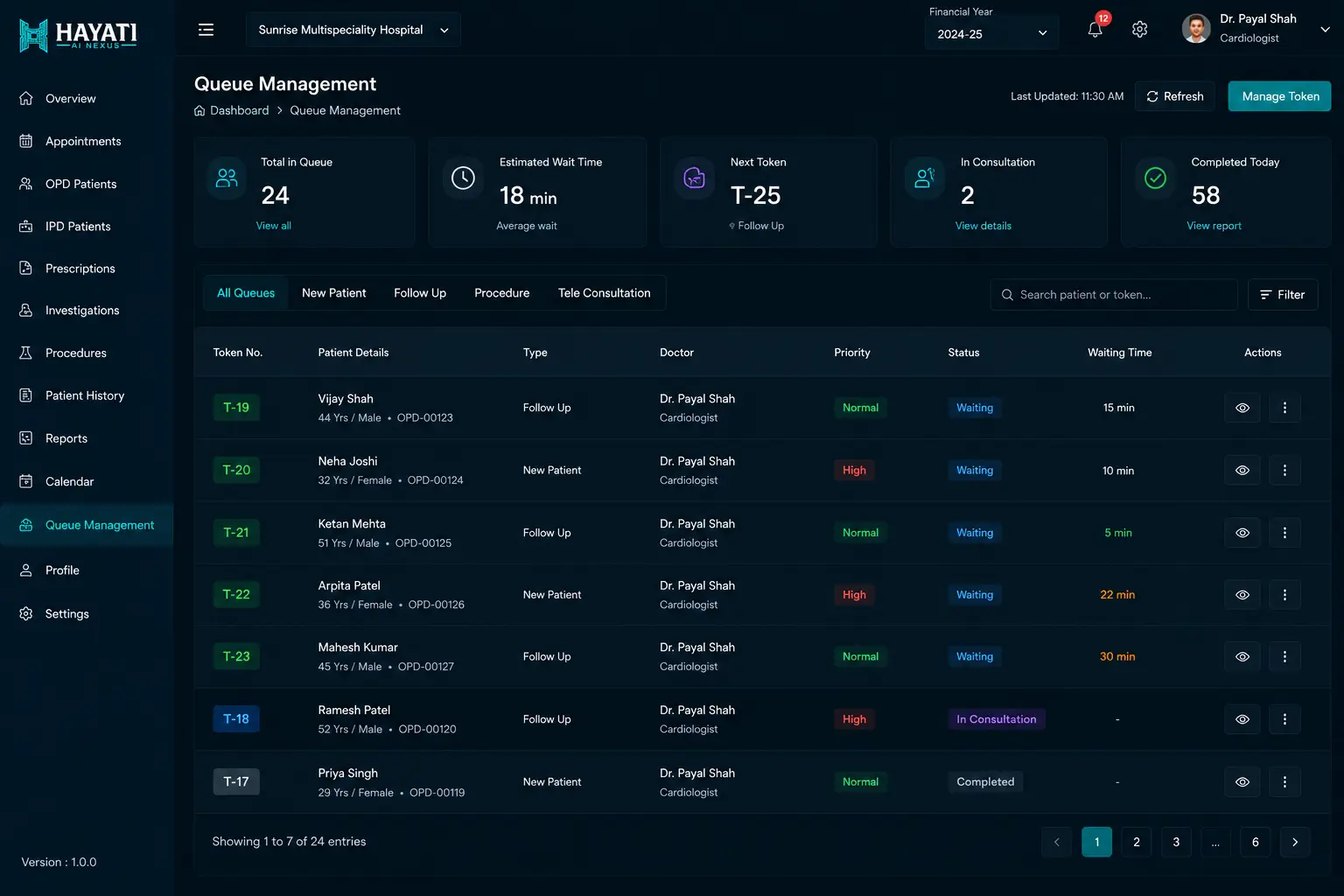
Hayati treats queue management as a workflow on one Healthcare Operating System—not a standalone display SKU. AI Receptionist or reception creates visit records on the Physical Appointment Dashboard with tokens and status colors reception staff actually use. Token slip print at check-in gives patients a physical reminder while the dashboard keeps the live order. Patient Queue Display reflects live order when displays are enabled—reducing desk crowding and repeat questions. Status changes (Waiting, In-Consultation, Completed) propagate to Doctor Dashboard so physicians see who is next without hallway noise. Billing counters can fetch the visit by token so GST billing and pharmacy inventory consume the same patient context without re-keying identity. TPA or credit flags attach before dispense when hospital workflows require it. Offline-first branches continue token and billing continuity locally, replaying queue and register events with multi-branch context when sync returns. Queue rules—walk-in priority, doctor-specific lines, emergency escalation—are configured with operations leaders during onboarding, not invented by software defaults alone.
Benefits for hospitals, clinics, and pharmacies
Waiting areas calm down when names and tokens match reality on a display patients can read. Reception spends less time repeating queue order and more time on exceptions. Physicians start consults with queue-aware context on Doctor Dashboard instead of guessing who shouted last. Pharmacy and billing counters reduce wrong-patient risk when queue and consult precede dispense. Operations managers review delay and no-show patterns with event records—not anecdote. Multi-branch groups compare OPD discipline across facilities when branch context survives sync. Hospital pharmacies attached to OPD gain one patient path from token to GST bill and batch pick. Benefits assume you still train staff on escalation and still handle emergencies manually—queue software does not replace triage judgment. Hayati targets operational fairness and explainability on one spine, not a vanity digital board.
AI integration on the queue workflow
AI Receptionist feeds the queue instead of bypassing it. After-hours calls become morning appointments with source metadata reception validates before check-in—missed calls stop being lost sticky notes. Governed scripts capture intent without clinical advice; emergencies escalate to humans per policy. AI Retention Agent may schedule follow-ups that re-enter queue rules on later visits—never jumping the line silently. AI does not auto-mark patients In-Consultation or alter finalized bills; it reduces intake gaps that become queue chaos at 10 AM. Language packs and escalation matrices are scoped per branch during pilot. Measure missed-call conversion and correction time—not vendor claims we do not publish. Queue management plus AI works when operations owns the rules; technology enforces what leaders already agreed is fair.
Connected modules on one Healthcare Operating System
Queue management sits between intake and revenue modules on Hayati AI Nexus: AI Receptionist for calls and booking handoff; Physical Appointment Dashboard and this queue workflow for token order; Patient Queue Display for waiting-room screens; Doctor Dashboard for consult handoff; GST billing and offline billing for register continuity; pharmacy inventory for dispense after consult; TPA billing alignment for payer-linked hospital pharmacy cases; multi-branch governance for governed sync and HQ visibility. Product and platform pages describe architecture; this page describes front-of-house workflow on that spine. Walkthroughs should simulate walk-ins plus AI bookings, one In-Consultation transition, one pharmacy handoff, and one offline catch-up—not only a static display mockup.
Comparison: standalone queue displays vs Healthcare OS workflow
Standalone queue TV apps fit buyers who only need a name on a screen. Hayati fits when queue order must stay tied to consult, billing, inventory, TPA, offline continuity, and branch policy. Practo-class appointment tools stop at booking—they do not run dispensary GST or hospital TPA alignment. Generic HMS queues may weakly connect to billing offline. Hayati's comparison claim is narrow: one patient journey from token to bill—not the cheapest display player. If your only pain is a waiting-room TV with no pharmacy or payer complexity, a lighter tool may suffice until OPD and dispensary share one counter team.